

I had a call a few weeks ago about an AI design strategy role.
The problem I’ve had in the later stages of interviewing is that I don’t have a lot to show. The pieces I’ve written on this site are the extent of what I’ve got to show for my time at Oracle. So, when asked for an example of my thinking, I couldn’t just point at a portfolio.
The interviewer was leaving for Hawaii for a week, which gave me a deadline I didn’t ask for. I had a week and one idea I trusted, and the idea was to build something real for one of their actual clients: Scouting America.
I picked them because I’ve lived inside the problem, and the problem isn’t the one most people assume. Cub Scout families almost never quit because Scouting is bad. They quit because communication is a dumpster fire — they never quite figure out how to get engaged, so they don’t, and one quiet Tuesday they’re just gone.
Scouting America already invented the job to fix this. It’s called the New Member Coordinator, and the role’s own description asks the holder to “promote Scouting through social media” and “design well-distributed invitations” — marketing, in other words, listed as a chore. Only a small fraction of packs ever fill the role. The org runs a bootcamp for it that opens, no kidding, with “Are you excited about Scouting but have little marketing experience?” They built a position that requires a craft almost none of their volunteers have, and then acted surprised when it sat empty.
That’s the thing I wanted to build: a New Member Coordinator that doesn’t need a marketer in the chair. A system that does the family-communications work the volunteer can’t keep up with, in the pack’s own voice, on the channel parents actually read. The kind of job AI is genuinely shaped for — tireless, personalized.
I started building the thing I’d want to show off: an interactive prototype of what this tool would actually put on a parent’s phone. You’d type a question — what does my kid even need for the first meeting — and an answer would come back in the pack’s own voice, in a thread that looked like the texts already sitting on your phone. Somewhere around Wednesday I did the math and saw I wasn’t going to make it. So I ripped the working parts out and rebuilt it as a page you scroll. No model. No animation. The argument, sitting still, holding even.
I expected to feel like I’d settled. I didn’t. The Hawaii deadline had quietly steered me off the thing I wanted to build and onto the thing that actually made the case.
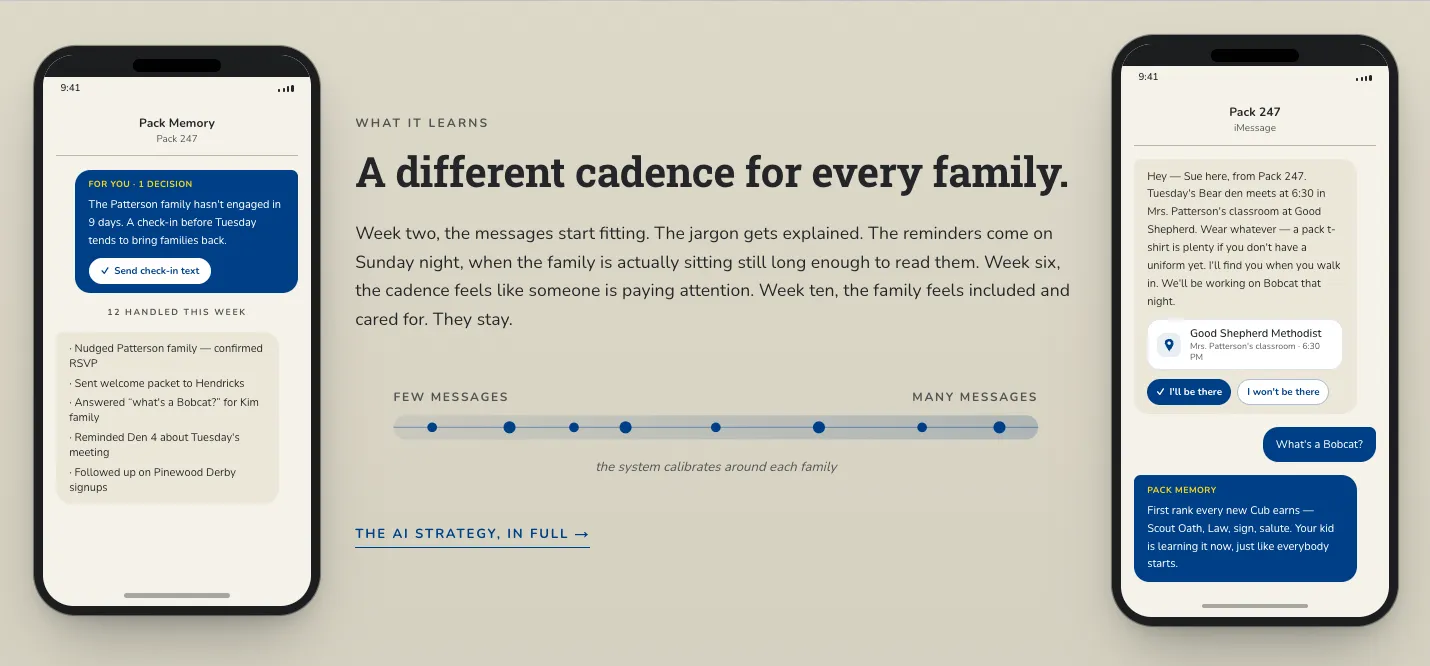
Here’s what a working chatbot does the moment you hand it to someone: it tells them their job is to break it. Ask the weird question. Find the seam where the AI shows through. No longer focused on the big idea.
For most of my career I was about the flash. The interactive thing. The part that makes a room go ooh. I’m not anymore. The flash is the easiest part to make now, and it’s the first thing that pulls people away from whatever you were actually trying to say.
So I sent him the quiet version, finished the day he flew home.
It’s at jeremyfuksa.com/nmc. A week of work barely scratches the surface of a problem this old, but it’s a strong beginning and, ultimately, a great way to keep families from quietly fading out of Cub Scouts.